
America’s Water Advantage: It Will Help Carry Us Through the Next Storm
From our blue-water navy and deep-water ports to navigable rivers and freshwater reserves, water is one of the most powerful geographic advantages America has ever had

Estimated read time is 6 minutes — enjoy!
From well before independence, water shaped America’s rise to global power, offering foundational advantages in security, transportation, trade, agriculture, and manufacturing. No other nation has enjoyed such a rare combination: two broad oceans separating it from major adversaries, a string of deep-water ports on both coasts, a vast network of navigable rivers and protected coastal waterways, and abundant freshwater. In a world where geopolitics are returning with a vengeance, America’s sea power and water abundance remain among its greatest—yet most underappreciated—strengths.
This post explores the deep-rooted structural edge those assets have provided—and why they’ll matter even more in the uncertain times ahead.
The Greatest Deep-Water Power in History
Let’s start at sea. America benefits from two natural moats—vast oceans that place thousands of miles between us and the world’s other great powers. That insulation alone provides enormous security—but we didn’t stop there. Over more than two centuries, America has built the most formidable naval force in history, able to project power in ways the Royal Navy could have hardly imagined. While China’s navy may now surpass ours in raw ship count, the U.S. Navy maintains nearly double the tonnage and far superior capabilities across the board. We have more carrier strike groups (11), amphibious assault ships (9), and nuclear-armed submarines (14) than the rest of the world combined. As a result, we dominate the open oceans with unmatched logistical reach, technological sophistication, and global striking power.
But in some ways, our true strength rests on our foundation of deep-water ports—providing access to the world’s two most important trade basins. The United States has more naturally protected harbors—many connected to vast inland waterways—than any other country. Spread across both the Atlantic and Pacific coasts, these strategic hubs—including New York, Norfolk, Charleston, Los Angeles, Oakland, Seattle, and many more—have long handled ever-expanding volumes of global trade. Unlike most nations, which rely on one or two key ports and face chokepoints or geographic vulnerabilities, America’s maritime geography is unusually vast, distributed, and resilient.
As Peter Zeihan puts it, no other country has ever been so naturally wired into the global ocean system while also being so internally self-sufficient. We can plug into global trade with ease and choose to protect sea lanes in exchange for allies joining our strategic orbit—but we don’t rely on either for our survival. That’s an unmatched luxury.
The Power of Rivers and Coastal Waterways
If deep water gave us security and global reach, shallow water built our internal economy. The United States has the most economically developed and interconnected network of navigable rivers in the world; no other country matches its scale. Historically, this provided an ease of internal transport that helped regions specialize, trade efficiently, and build capital—generating wealth without the friction that plagued less-connected economies. From the mighty Mississippi and its key tributaries—the Ohio, Illinois, and Missouri—to the Hudson and Columbia Rivers, our waterways served as the original superhighways of American commerce.
America’s rivers have long enabled low-cost, high-volume transportation of bulk goods. In the early 19th century, this system was augmented by the Erie Canal—which linked the entire Great Lakes region to the Atlantic trade basin. And when the steam engine arrived, we could suddenly move upstream—from New Orleans to Pittsburgh, Kansas City, St. Louis, and many other cities—bringing goods, people, and capital both ways.
We often fail to appreciate how important our river system still is to the U.S. economy. Today, about eight percent of all long-distance freight—including three-fifths of grain exports and one-fifth of domestic oil and coal—moves along inland waterways. Having a cheap and efficient way to transport bulk goods—far less expensive than rail, trucking, or air—remains a tremendous advantage. And we do so while being naturally protected from external threats, a rare geographic luxury. No other nation combines this level of internal connectivity with economic scale and strategic security.
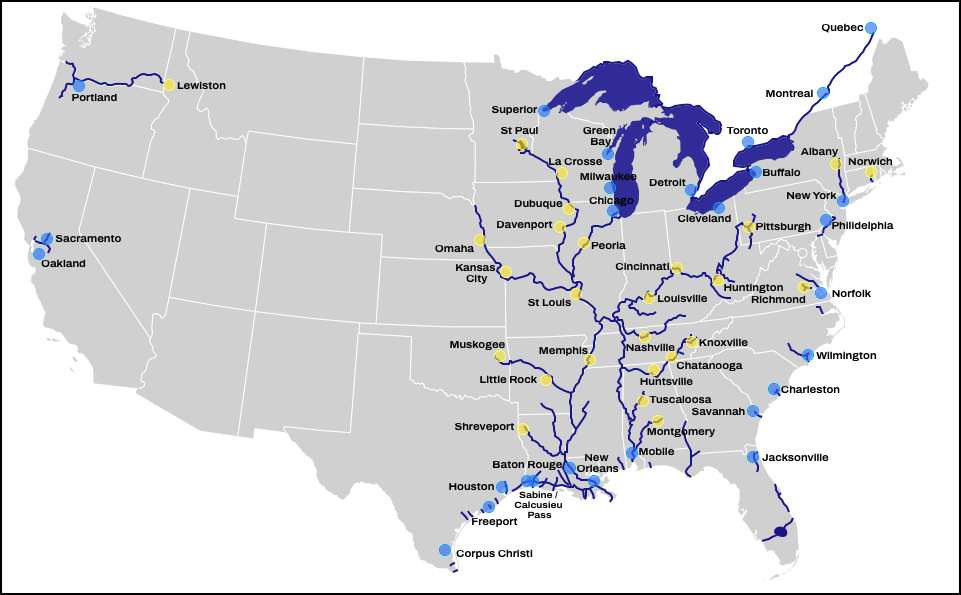
Beyond our inland rivers, the Atlantic and Gulf coasts add yet another layer of efficiency. Protected by barrier islands and gentle estuaries, they offer safe and stable intracoastal waterways that shelter ships from harsh weather and enable year-round regional trade. These routes transport approximately nine percent of all long-distance freight, carrying bulk goods like chemicals, aggregates, grain, oil, and coal.
One final aspect of our river systems is worth remembering: their ability to generate energy. In the early days of American industry, rivers throughout the Northeast and Midwest—from Lowell, Massachusetts to Richmond, Indiana—fueled the rise of water-powered mills, where rushing streams were harnessed for mechanical work. Today, that legacy continues at scale: massive dams on some of our largest rivers generate hydroelectricity, supplying about 2.5% of the nation’s total energy consumption.
Fresh Water and Agricultural Resilience
While river and coastal transport remains important, our greatest water advantage today may simply be this: we have a lot of it. Only a handful of countries—Canada, Russia, Brazil—have more freshwater on paper. But none match America’s combination of abundance, accessibility, and economic utility. On a warming planet, that advantage cannot be overstated.
The Southeast, Northeast, Midwest, and Pacific Northwest all enjoy ample rainfall and fertile soil—supporting some of the most productive farmland on Earth (more on that next week!). Much of this land doesn’t even need irrigation—but if and when it does, the nation is covered in lakes and rivers that can support it.
Even the Great Plains—rightly portrayed as quite dry—sit atop one of the largest aquifers in the world: the Ogallala. While this underground water source is being depleted too quickly, it remains a massive reserve that supports tens of millions of acres of farmland.
The Southwest (including much of California), by contrast, is clearly our most vulnerable region. As Marc Reisner detailed four decades ago, its cities and farms became over-reliant on ambitious—sometimes foolhardy—water diversion projects, drawing heavily from the Colorado River and the snowmelt-fed rivers of the Sierra Nevada. Those systems are now buckling under mounting climate stress. That’s especially troubling because California, in particular, contains some of our most productive farmland for specialty crops like fruits, vegetables, and nuts. In a future post, I’ll return to this problem with specific ideas for how to address it.
What sets America apart isn’t that every region has ideal water conditions—it’s that we have options. Our massive resources give us room to maneuver as drought becomes a global flashpoint. And for good measure, we sit just south of the most water-rich nation in the world. While other continents face growing water and food insecurity, we’re likely to become the supplier others depend on. It’s time we started viewing water not just as a resource, but as a strategic advantage.
Conclusion: Water Still Matters
We like to think of history as a story of peoples, inventions, or institutions—and it is. But geography is the skeleton beneath it all. It sets the stage for what’s possible. America’s water advantage—its rivers, ports, lakes, rainfall, and oceans—has quietly underpinned centuries of national security, economic development, and environmental resilience. It let us feed ourselves while selling to the world. In the decades ahead, as climate pressures mount and global supply chains falter, these advantages will matter more than ever. Water built America. And it will help carry us through the next storm.
COMING NEXT MONDAY: America’s Land Advantage — from vast arable farmland to low population density and room to adapt, we’ll explore how size, space, and soil have dramatically reinforced America’s strength and resilience.