
Creating New States is Easier Than You Think
The case for using statehood, not amendments, to fix America’s most undemocratic institution

Estimated read time is 6 minutes — enjoy!
Over the past several weeks, I’ve returned to an argument from my book Closing the Urban-Rural Power Divide: that restoring fairness to American democracy may require a City-State Revolution—the partition of large states into smaller, more representative units. Politically, this wouldn’t be easy. Our system has stagnated to the point where any structural reform feels impossible. But technically, carving new states from existing ones is remarkably straightforward—far easier than amending the Constitution.
Why focus here? Because while many reforms could make American government function better—moving to multi-member House districts, establishing inviolable voting rights, restructuring the courts—all of them would become easier to adopt if the Senate were more proportional. The chamber’s malapportionment is the root veto point of our system, locking in minority rule and blocking democratic change. Pursuing a City-State Revolution would be a heavy lift, but it’s one of the only viable ways forward. If Democrats are serious about governing, they need to start planning now—so that when they secure a federal trifecta, they’re ready to act.
Statehood and the Admissions Clause
The mechanism for creating new states is contained in Article IV of the Constitution, in what is known as the Admissions Clause:
“New States may be admitted by the Congress into this Union; but no new State shall be formed or erected within the Jurisdiction of any other State; nor any State be formed by the Junction of two or more States, or Parts of States, without the Consent of the Legislatures of the States concerned as well as of the Congress.”
That single sentence provides the framework. Congress has already used this power many times, admitting 37 new states to the union. Most came from territories acquired through war or treaty, but four—Vermont, Kentucky, Maine, and West Virginia—were carved directly from existing states.
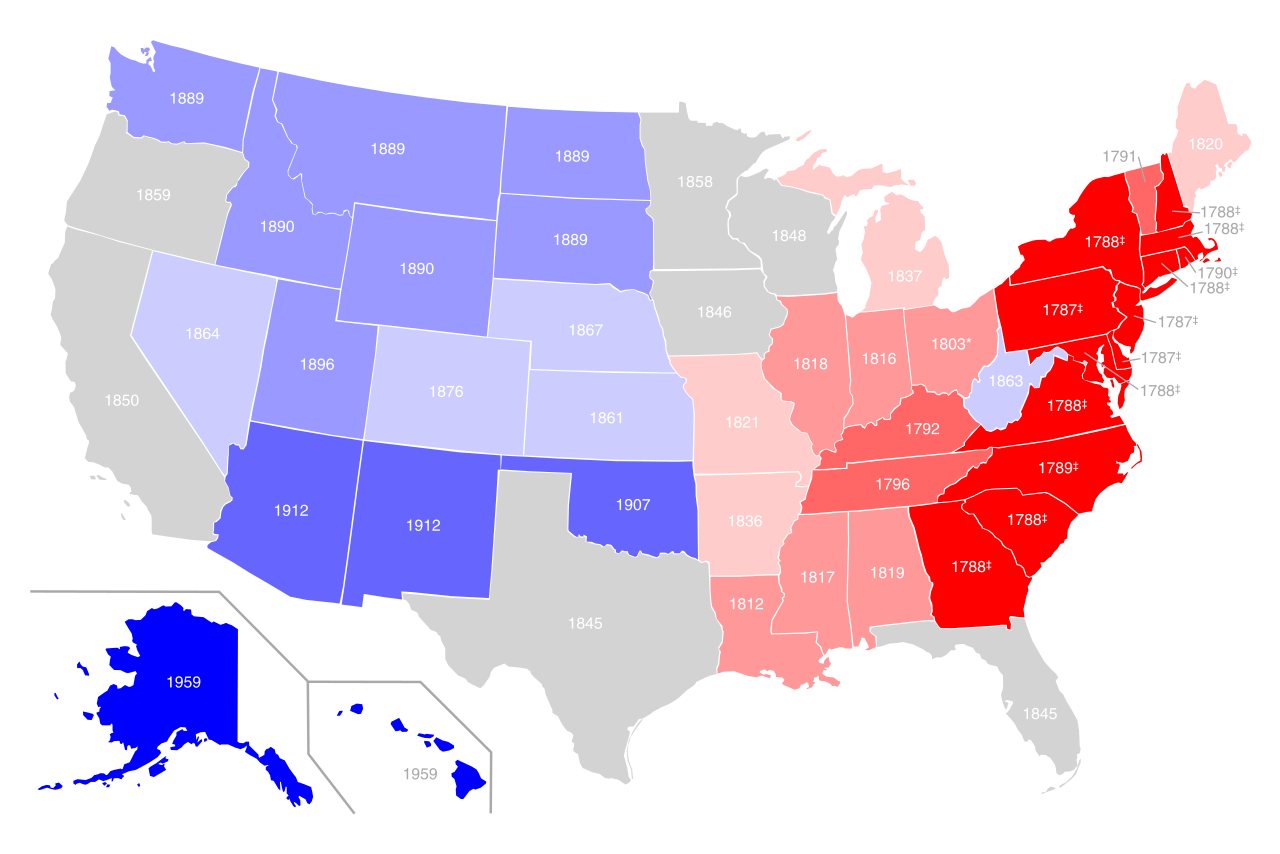
These partitioning examples illustrate how the clause works in practice. Vermont, long disputed between New York and New Hampshire, declared independence during the American Revolution but wasn’t admitted until New York agreed to the split in 1790—after receiving a $30,000 payoff. Kentucky, originally Virginia’s western county, gained statehood in 1792 once Virginians formally consented to the division. Maine’s post-War of 1812 frustrations with absentee rule from Boston led to its separation from Massachusetts in 1820 as part of the Missouri Compromise. West Virginia’s case was more violent: its unionist mountain counties broke from Confederate Virginia during the Civil War and were admitted in 1863, with the Supreme Court later upholding the arrangement.
These examples underscore two key facts. First, partitioning states is hardly novel—it was deliberately built into our system and has been used multiple times. Second, admission requires only three approvals: consent from the state legislature, majorities in both chambers of Congress, and a presidential signature. No supermajority is required—a striking contrast to constitutional amendments, which must clear daunting hurdles at both the proposal and ratification stages.
That means the greatest immediate hurdle is not constitutional but procedural: the Senate filibuster. As long as it remains, any attempt at statehood could be blocked by just 41 senators representing a small fraction of the population. Democrats would therefore need to eliminate the filibuster—something that itself requires only a simple majority—at least for statehood votes. If they did, the pathway would be open.
The Case for an Enabling Law
While the Admissions Clause sets the bare constitutional rules, it leaves much unsaid. Historically, Congress often passed what were known as enabling acts—legislation establishing the conditions for the admission of new territories (or parts of territories). Today, although not constitutionally required, such a law is politically essential. Without it, the process of creating new states could quickly fall prey to partisan manipulation—little more than gerrymandering on steroids. An enabling law could establish neutral, transparent guardrails to ensure that state creation strengthens democracy rather than serving a single political party.
What might such a law include? Above all, it must advance proportional representation by favoring the creation of compact city-states—so that political power follows people, not empty land. In Closing the Urban-Rural Power Divide, I laid out six guiding principles:
Population. New states should meet a minimum size requirement. The U.S. already has too many small states—often with vast geographies but only six or seven hundred thousand residents. Setting a higher threshold, say two million people, would prevent the creation of micro-states and help ensure the Senate becomes more proportional. It would also make it easier to pursue other needed reforms, which I’ll discuss in later posts.
Community. Statehood should reflect real political and cultural identities. The best building blocks are metropolitan statistical areas, which capture how people actually live and work. These city-states should not be cobbled together with unrelated rural counties to manufacture partisan advantage. Wherever possible, they should empower coherent communities of interest, including majority-minority jurisdictions that have historically been underrepresented. And it’s worth noting that this doesn’t necessarily benefit Democrats, given recent shifts in political preferences among nonwhite voters.
Borders. Rather than arbitrary colonial boundaries or straight lines, new state borders should follow contemporary county or metropolitan boundaries. This keeps the process clear, transparent, and aligned with existing governance.
Debt. Partition should not allow wealthy metropolitan areas to escape their fiscal obligations. New states must assume a fair share of the debts of their parent states, weighted by both population and income levels. This ensures fairness and makes partition politically palatable to those making the decision.
Infrastructure. Modern society depends on shared systems—energy grids, water networks, roads, transit, and more. An enabling law must require new states to assume responsibility for maintaining and coordinating critical infrastructure across borders. Without such safeguards, partition could trigger economic disruption.
Water Rights. Especially in the West, interstate water compacts are lifelines. A federal planning commission should oversee transitions, ensuring new states inherit both the rights and the responsibilities of existing agreements. Without this, legal chaos could follow.
Taken together, these principles would prevent a City-State Revolution from becoming a tool for partisan gamesmanship. The goal is not to guarantee one party’s dominance, but to restore balance to a Senate where sparsely populated rural states wield wildly disproportionate power. Urban areas would gain fairer representation, but rural regions would benefit as well. In fact, in many progressive parts of the country, conservatives have reason to support this approach—since it would allow them to form coherent federated states no longer yoked to distant metropolitan centers.
Passing an enabling law would therefore be a politically smart starting point—a signal to the country that this movement is about democratic fairness, not partisan advantage. Once established, the framework could guide partition efforts in states where both local and national political coalitions see benefit in a more representative Senate.
Conclusion
From a technical perspective, a City-State Revolution is straightforward. Congress has the power. States can consent. No constitutional amendment is required. But politics, of course, is another matter. Achieving reform will require building a genuine movement—one that convinces Americans that new states are not a threat but a path back to fairness. If the public can be persuaded, political leaders will follow.
COMING NEXT WEEK: I’ll explore what the beginning of a City-State Revolution might look like by admitting Washington, D.C. and Puerto Rico—both heavily urban places—as an opening step toward transforming the Senate into a body that truly reflects the people it is meant to represent.